Does Gum Disease Kill You? Facts, Links and Warning Signs
What gum disease does, its links to other illnesses and when symptoms are urgent.
Checked by our editorial team. Clinical review by a dentist: planned, not yet done for this article.

Does gum disease kill you? Not directly. Cleveland Clinic states that periodontal disease is not life-threatening in itself, but it notes links with heart disease, stroke and diabetes, and untreated infection can spread. In the UK, the NHS warns that gum disease can lead to abscesses and tooth loss.
Headlines linking gums to heart attacks can make a bit of bleeding when brushing feel alarming. The reality is more measured: gum disease is common, treatable at the early stage and manageable later on, but it is not harmless. This guide separates what is established from what is a link, and explains when gum symptoms become urgent.
What does gum disease actually do?
The NHS says gum disease is caused by a build-up of plaque on the teeth. Left untreated, it can lead to bad breath, shrinking gums, loose or lost teeth and dental abscesses. The Oral Health Foundation explains that early gum disease (gingivitis) can progress to periodontal disease, which damages the bone and tissues holding teeth in place. Cleveland Clinic describes how untreated disease can destroy the jawbone that supports teeth.
Is gum disease linked to other illnesses?
Cleveland Clinic says there is a link between gum disease and other health issues like heart disease, stroke and diabetes, and that infection can spread to other parts of the body. It is important to read “link” carefully: an association means the conditions often occur together and may influence each other, not that gum disease alone causes them. The NHS recommends regular dental check-ups for people with type 2 diabetes and during pregnancy, which reflects how closely these areas are connected.
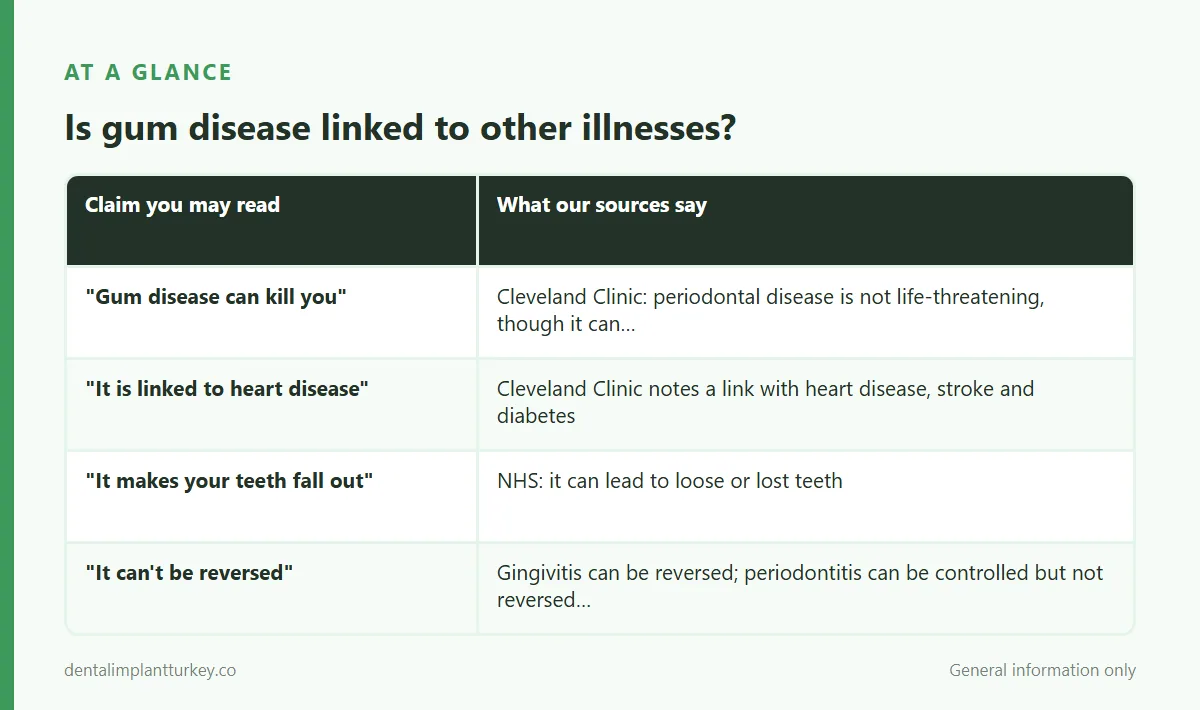
| Claim you may read | What our sources say |
|---|---|
| “Gum disease can kill you” | Cleveland Clinic: periodontal disease is not life-threatening, though it can lead to other conditions needing treatment |
| “It is linked to heart disease” | Cleveland Clinic notes a link with heart disease, stroke and diabetes |
| “It makes your teeth fall out” | NHS: it can lead to loose or lost teeth |
| “It can’t be reversed” | Gingivitis can be reversed; periodontitis can be controlled but not reversed (Oral Health Foundation) |
When can a mouth infection become dangerous?
Infections in the mouth, such as a dental abscess, can occasionally spread. The NHS toothache page advises going to A&E, or calling 999, if the area around your eye or your neck is swollen, or if swelling in your mouth or neck is making it hard to breathe, swallow or speak. The NHS gum disease page lists very painful, swollen gums, loose or falling-out teeth, ulcers or red patches in the mouth and lumps in the mouth or on the lip as reasons for an urgent dental appointment.
How do I lower the risk?
- Brush at least twice a day with fluoride toothpaste and spit rather than rinse (NHS).
- Clean between your teeth daily with floss or interdental brushes.
- Do not smoke; the NHS lists it among the things to avoid.
- Keep regular dental check-ups, especially if you have diabetes or are pregnant.
- Treat bleeding gums as a prompt to see a dentist or hygienist, not as something to wait out.
Our guide to preventing gum disease covers technique in more detail.
What treatment is available?
Cleveland Clinic says gingivitis is fully reversible with cleaning and better hygiene, while advanced disease can be managed with scaling and root planing, pocket reduction surgery and grafts. The NHS lists cleaning by a hygienist and stop-smoking support for early stages, and deep cleaning under the gums, antibiotics, tooth removal or gum surgery for more serious cases.
Questions to ask at your next appointment
- Do I have gingivitis, periodontitis or neither?
- How often should I have hygiene appointments?
- Does my diabetes, pregnancy or medication affect my gums?
- Which interdental cleaning tools suit my teeth?
For diet tips that support gum health, see the best foods for healthy teeth and gums.
Sources
- Cleveland Clinic, Periodontal Disease (Gum Disease)
- NHS, Gum disease
- NHS, Toothache
- Oral Health Foundation, Gum disease
This article is general information and is not a substitute for advice from your own dentist.