Which Teeth Fall Out at Age 10? A Parent’s Guide
A chart of when baby teeth are usually lost, with what to expect around age 10.
Checked by our editorial team. Clinical review by a dentist: planned, not yet done for this article.
Which teeth fall out at age 10? Usually the baby canines and baby molars at the sides and back of the mouth. Lower canines and first molars often go between 9 and 12, and the upper canines and second molars between 10 and 12.
Parents often notice a lull. The front teeth tend to come out around age 6 to 8, then nothing much seems to happen for a while, and suddenly around ten or eleven the back teeth start wobbling. A rough timetable helps you tell normal changes from something worth showing a dentist. Timings vary from child to child, so treat the ages below as a guide rather than a deadline.
When does each baby tooth usually fall out?
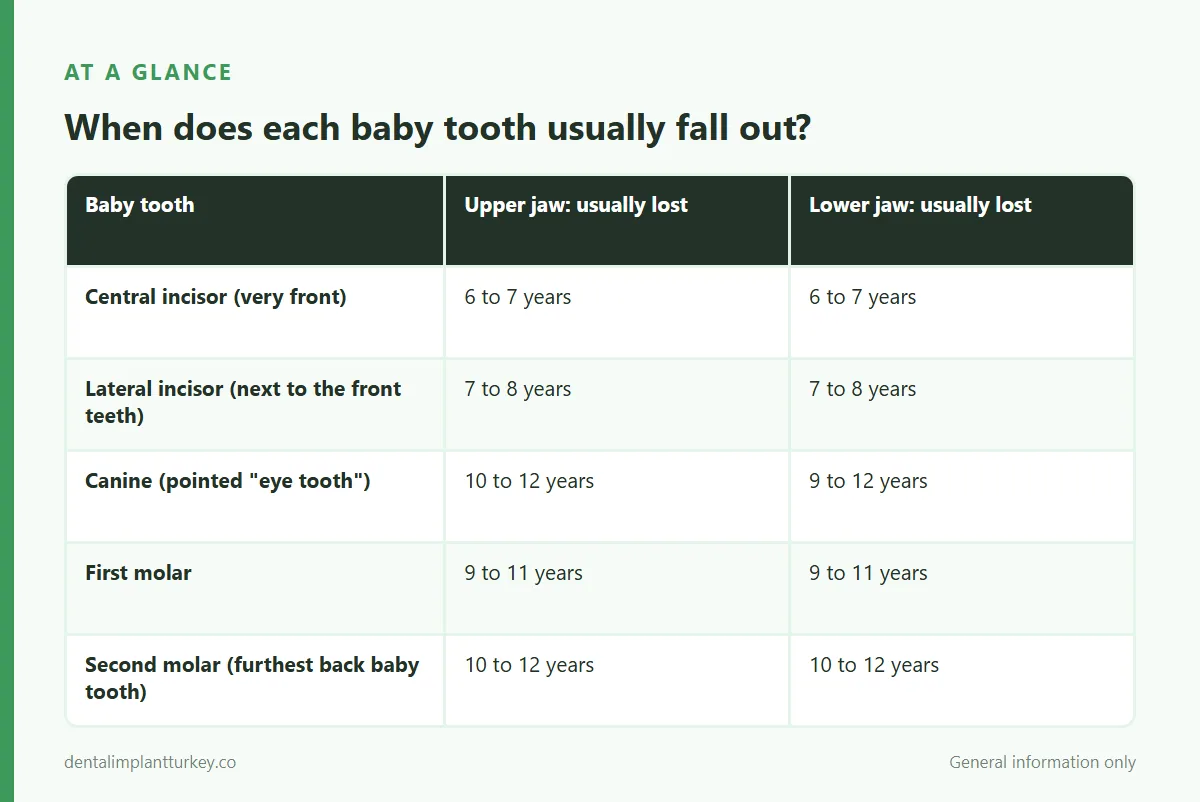
This chart is based on Cleveland Clinic’s primary teeth timetable. Upper and lower teeth are listed separately because they do not always go at the same age.
| Baby tooth | Upper jaw: usually lost | Lower jaw: usually lost |
|---|---|---|
| Central incisor (very front) | 6 to 7 years | 6 to 7 years |
| Lateral incisor (next to the front teeth) | 7 to 8 years | 7 to 8 years |
| Canine (pointed “eye tooth”) | 10 to 12 years | 9 to 12 years |
| First molar | 9 to 11 years | 9 to 11 years |
| Second molar (furthest back baby tooth) | 10 to 12 years | 10 to 12 years |
So at ten, it is common for a child to be losing first molars and lower canines, with upper canines and second molars to follow over the next couple of years.
What is the overall order of losing baby teeth?
- Around 6: Sheffield Children’s NHS Foundation Trust says children begin losing baby teeth around this age, usually the lower and upper front teeth first.
- Next: Sheffield Children’s says the first big adult teeth at the back, the first permanent molars, come through.
- 7 to 8: The lateral incisors either side of the front teeth.
- 9 to 12: The canines and baby molars.
- Around 12: Sheffield Children’s says the last baby tooth is usually lost around this age.
Children have 20 baby teeth, which are usually all through by around age three, according to Norfolk and Suffolk NHS. These are gradually replaced, making way for 32 adult teeth in total.
Is it normal if my 10-year-old hasn’t lost these teeth yet?
Usually, yes. The ranges in the chart are wide because children develop at different rates, and Cleveland Clinic notes that timings vary from child to child. A child who lost their front teeth later than friends may well lose their back teeth later too. If you are unsure, raise it at your child’s next routine dental visit.
Signs worth mentioning to the dentist
- an adult tooth coming through behind a baby tooth that has not loosened
- a wobbly tooth that has been loose for a long time without coming out
- pain, swelling or a bad taste around a loose tooth
- a large difference between the left and right sides of the mouth
- a knocked-out tooth after an accident
How to look after the new teeth coming through
The adult molars and canines arriving now have to last a lifetime, so this is a good stage to tighten up routines. Sheffield Children’s NHS Foundation Trust and Norfolk and Suffolk NHS advise:
- Brush twice a day: last thing at night and at one other time.
- Use a pea-sized amount of fluoride toothpaste for children over three. Sheffield Children’s recommends a toothpaste containing 1,450ppm fluoride.
- Supervise brushing until your child is at least 7.
- Keep sugary snacks and drinks to a minimum, with water and milk as the main drinks.
- Take your child for regular dental check-ups.
Our 10 dentist-approved tips for healthy teeth works for the whole family, and if you are budgeting for check-ups, family dentist prices in the UK explains what to expect. NHS dental treatment is free for children under 18.
Sources
- Cleveland Clinic, Teething: Symptoms & Tooth Eruption Chart
- Sheffield Children’s NHS Foundation Trust, Looking after your teeth
- Norfolk and Suffolk NHS (Integrated Care Board), Taking care of children’s teeth
- NHS, Who can get free NHS dental treatment
This article is general information and is not a substitute for advice from your own dentist.