Why Are My Teeth Sensitive All of a Sudden?
A symptom guide to sudden tooth sensitivity, home care and when to see a dentist.
Checked by our editorial team. Clinical review by a dentist: planned, not yet done for this article.

If you are asking “why are my teeth sensitive all of a sudden”, the usual culprits are worn enamel, receding gums, a cracked tooth, decay, recent dental work or tooth whitening. Sudden sensitivity, or sensitivity in one tooth, should be checked by a dentist.
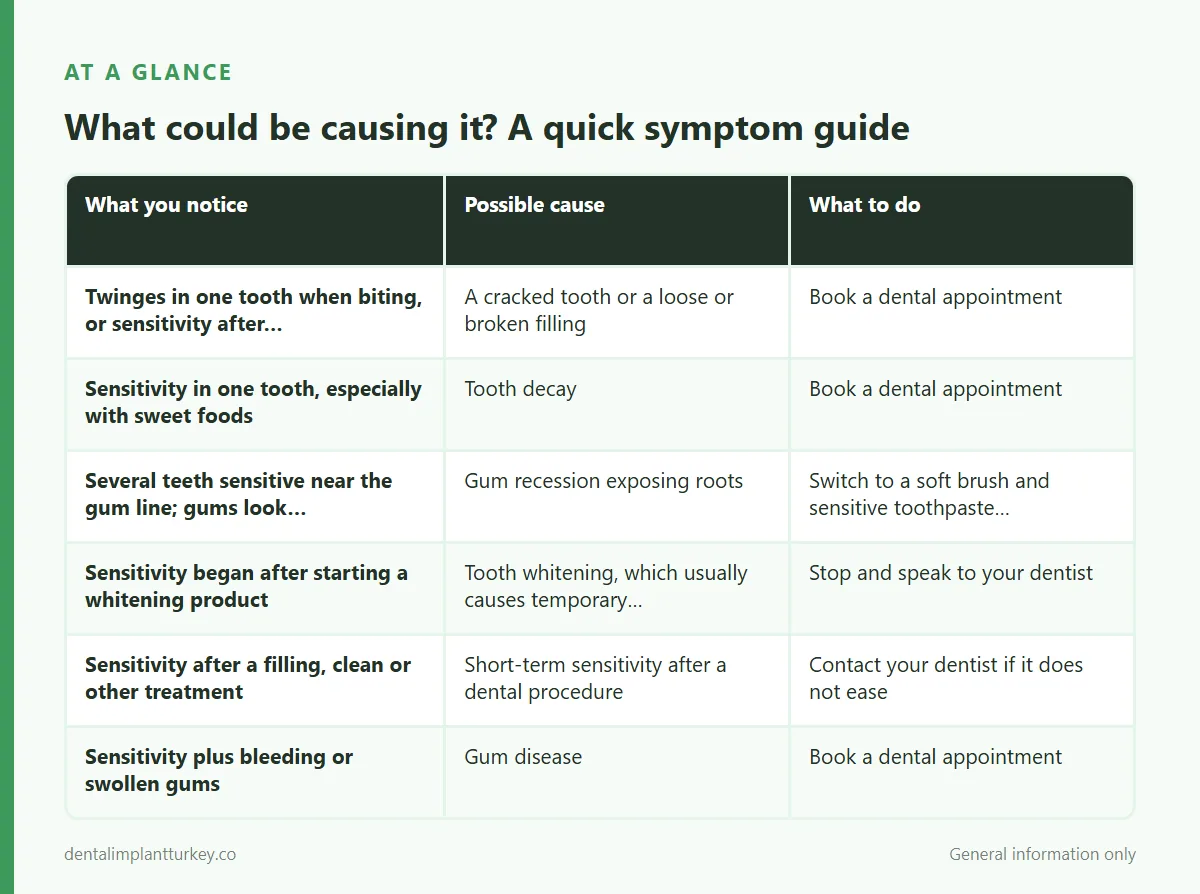
Sensitivity happens when the softer layer under your enamel, called dentine, becomes exposed. The Oral Health Foundation explains that this lets hot, cold, sweet or acidic triggers reach the nerve, causing a quick sharp pain or a longer ache. Sometimes the exposure builds up quietly for months and only becomes noticeable one day. Other times something genuinely new has happened. The table below helps you think through which is more likely, before you see your dentist.
What could be causing it? A quick symptom guide
| What you notice | Possible cause | What to do |
|---|---|---|
| Twinges in one tooth when biting, or sensitivity after biting something hard | A cracked tooth or a loose or broken filling | Book a dental appointment |
| Sensitivity in one tooth, especially with sweet foods | Tooth decay | Book a dental appointment |
| Several teeth sensitive near the gum line; gums look like they have shrunk back | Gum recession exposing roots | Switch to a soft brush and sensitive toothpaste; mention it at your check-up |
| Sensitivity began after starting a whitening product | Tooth whitening, which usually causes temporary sensitivity | Stop and speak to your dentist |
| Sensitivity after a filling, clean or other treatment | Short-term sensitivity after a dental procedure | Contact your dentist if it does not ease |
| Sensitivity plus bleeding or swollen gums | Gum disease | Book a dental appointment |
| You know you grind or clench your teeth | Grinding or clenching | Ask your dentist about a mouthguard |
| You drink a lot of fizzy drinks, juice or squash | Acid wear of enamel | Cut back on acidic drinks; wait an hour before brushing after them |
These causes are drawn from the Oral Health Foundation, Cleveland Clinic and the NHS. Cleveland Clinic also lists brushing too hard, plaque build-up and some mouthwashes as possible causes.
Why does sensitivity sometimes appear overnight?
Some causes really are sudden: a crack after biting on something hard, a filling that has broken, or a new whitening treatment. Others, such as gradual enamel wear or slowly receding gums, can reach a tipping point where enough dentine is exposed that you suddenly notice it. The Oral Health Foundation also notes that sensitivity becomes more common as we get older, because gums naturally recede over time.
When should you see a dentist?
The Oral Health Foundation says to see a dentist if the pain is severe, lasts more than a few weeks, affects only one tooth or starts suddenly. It adds that sensitive teeth can sometimes be a sign of a dental problem and should not be ignored.
The NHS advises seeing a dentist if toothache lasts more than 2 days or does not settle with painkillers, or if you have a high temperature, pain when biting, red gums, a bad taste or a swollen cheek or jaw. It advises going to A&E if the area around your eye or your neck swells, or swelling makes it hard to breathe, swallow or speak. If you do not have a dentist, the NHS suggests calling 111 for advice.
What can you do at home in the meantime?
- Use a toothpaste for sensitive teeth. The Oral Health Foundation suggests those containing potassium citrate, potassium nitrate or stannous fluoride. You need to keep using them to maintain the effect.
- Spit, don’t rinse after brushing, and try rubbing a little sensitive toothpaste onto the sore area at night.
- Brush gently with a soft brush in small circles.
- Wait an hour after acidic food or drink before brushing.
- Cut back on acidic and sugary drinks.
- Avoid very hot or very cold food and drink while the tooth is tender, as the NHS suggests for toothache.
How do dentists treat sensitive teeth?
Treatment depends on the cause your dentist finds. Options described by the Oral Health Foundation and Cleveland Clinic include:
- applying a desensitising treatment or fluoride varnish to the sensitive area
- recommending a high-fluoride toothpaste
- covering exposed roots with bonding or a filling near the gum line
- using a dentine sealant to block the tiny channels in the dentine
- treating gum disease, decay or a cracked tooth if one of those is the cause
If receding gums are behind your symptoms, our guide on how to prevent gum disease is a good next step, and how to protect your teeth from tooth decay covers the other common cause.
Sources
- Oral Health Foundation, Sensitive teeth
- Cleveland Clinic, Sensitive Teeth: Causes, Treatment & Prevention
- NHS, Toothache
This article is general information and is not a substitute for advice from your own dentist.