How Much Is a Filling Privately? NHS vs Private Compared
What drives private filling fees and how they compare with NHS charges.
Checked by our editorial team. Clinical review by a dentist: planned, not yet done for this article.

How much is a filling privately? There is no national price list. Private fees are set by each practice and depend on the material, the size of the cavity and the tooth involved. For comparison, an NHS course of treatment that includes fillings is Band 2, listed at £76.60 in England, however many fillings you need.
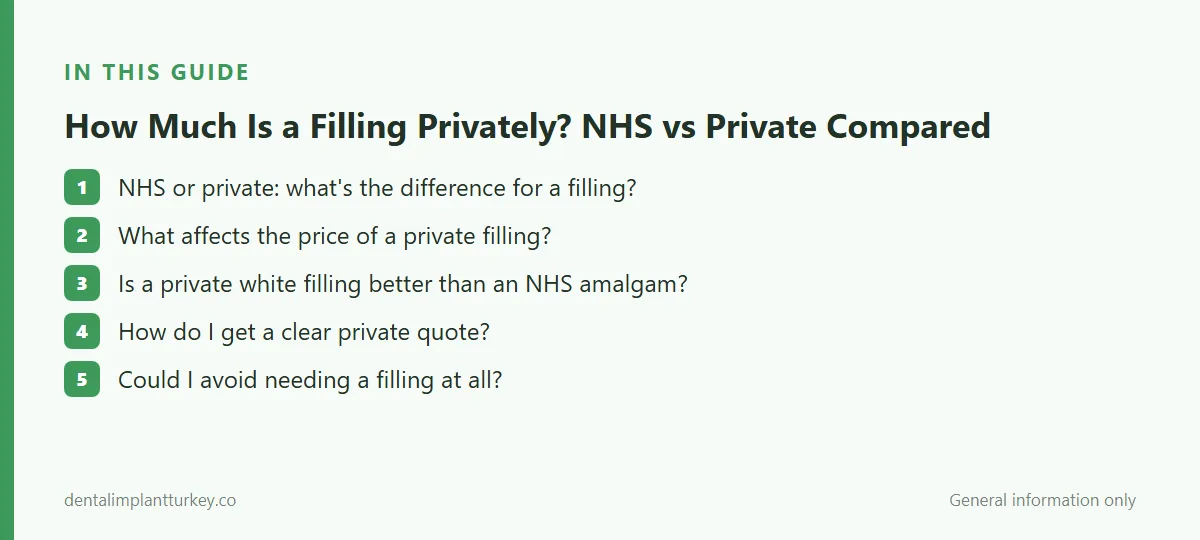
People usually ask about private fillings for one of three reasons: they cannot get an NHS appointment, they want a tooth-coloured filling on a back tooth, or they want more time with the dentist. This guide helps you decide whether going private is worth it for a filling, and what to ask so a quote is clear.
NHS or private: what’s the difference for a filling?
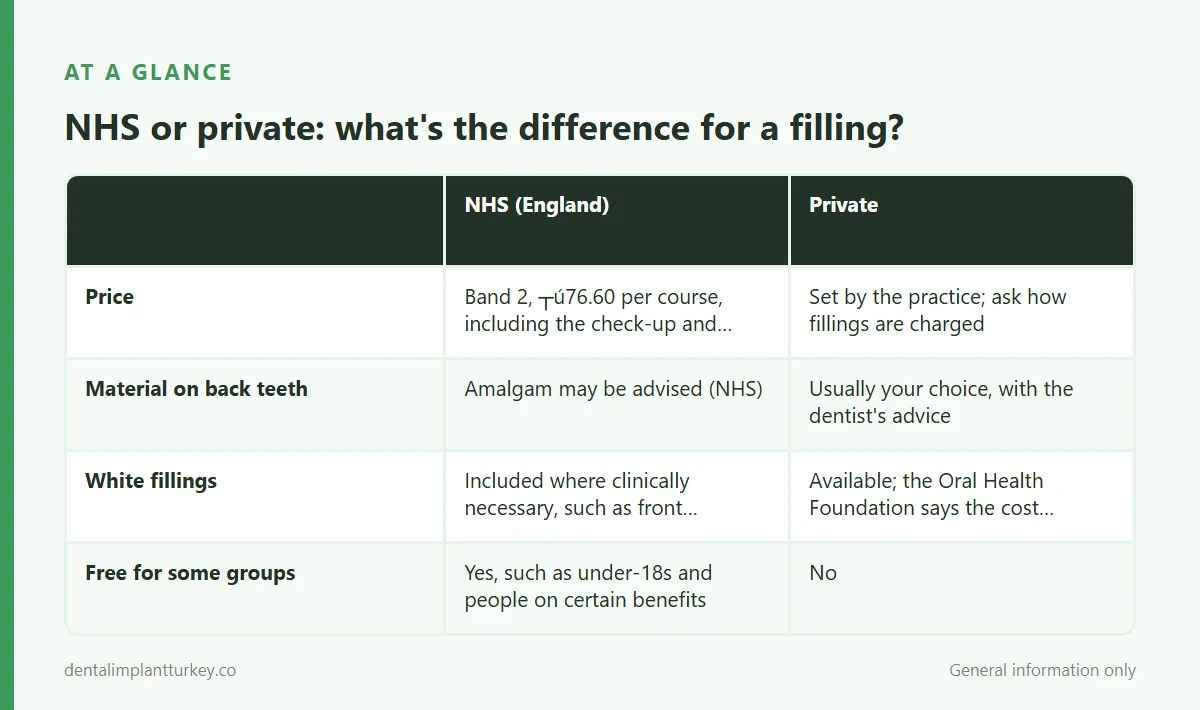
| NHS (England) | Private | |
|---|---|---|
| Price | Band 2, £76.60 per course, including the check-up and X-rays | Set by the practice; ask how fillings are charged |
| Material on back teeth | Amalgam may be advised (NHS) | Usually your choice, with the dentist’s advice |
| White fillings | Included where clinically necessary, such as front teeth (NHS) | Available; the Oral Health Foundation says the cost varies between practices |
| Free for some groups | Yes, such as under-18s and people on certain benefits | No |
What affects the price of a private filling?
- Material. Cleveland Clinic lists amalgam, composite resin and glass ionomer as fillings placed directly, and gold and porcelain as lab-made indirect fillings, which typically involve more work.
- Size and number of surfaces. A small filling on one surface is simpler than a large one wrapping around the tooth.
- Extras. An examination, X-rays or anaesthetic may be charged separately.
Is a private white filling better than an NHS amalgam?
Not automatically. The Oral Health Foundation says amalgam generally lasts longer and resists wear better, especially on back teeth, while modern white fillings are much stronger than older ones and in many cases last just as well. It also advises against swapping working silver fillings for cosmetic reasons, because removing a sound filling costs healthy tooth and can irritate the nerve. Cleveland Clinic says some fillings can last up to 20 years depending on the material. For an overview of composite, see our guide to protecting teeth from decay and the composite filling explainer on this site.
How do I get a clear private quote?
- Ask for a written treatment plan with costs before treatment starts, as the Oral Health Foundation recommends.
- Check whether the examination and X-rays are included.
- Ask which material is proposed for each tooth and why.
- Ask whether the price changes if the cavity turns out to be deeper than expected.
- Check what happens if the filling breaks or needs adjusting soon after.
Could I avoid needing a filling at all?
Sometimes. The NHS says fluoride varnish or a prescribed mouthwash can reverse early tooth decay, before a cavity forms. Once a hole is there, a filling is usually needed. Catching decay early through regular check-ups, which the NHS suggests every two years for adults, can keep treatment small.
Am I entitled to free NHS treatment instead?
The NHS lists groups who get free dental treatment in England, including under-18s, under-19s in full-time education, pregnant people and new mothers, and people receiving income-related ESA, Pension Credit Guarantee Credit or Universal Credit below an income threshold. The NHS Low Income Scheme can give full (HC2) or partial (HC3) help. For a fuller comparison, see NHS vs private dental costs.
Sources
- NHS, What is included in each NHS dental band charge?
- NHS, Get help with dental costs
- NHS, Tooth decay
- Oral Health Foundation, White fillings
- Oral Health Foundation, Dental amalgam fillings
- Cleveland Clinic, Dental Fillings
This article is general information and is not a substitute for advice from your own dentist.