What Is a Scale and Polish? What Happens and What It Costs
What a scale and polish involves, who carries it out and how NHS and private charges work.
Checked by our editorial team. Clinical review by a dentist: planned, not yet done for this article.
What is a scale and polish? It is a professional clean, usually carried out by a dental hygienist or therapist, that removes plaque and hardened tartar from your teeth and then smooths the surfaces. On the NHS it is a Band 1 treatment when clinically needed.
Many people book one without being sure what it involves, whether it is necessary or why it sometimes costs extra. If you have your first appointment coming up, this guide covers what happens in the chair, how it differs from brushing at home, and how NHS and private charges work.
What happens during a scale and polish?
The appointment has two parts, and each does a different job.
- Scaling. The NHS describes this as carefully removing the plaque and tartar that build up on your teeth. Tartar, Cleveland Clinic explains, is hardened dental plaque, made mostly of mineralised dead bacteria. The hygienist removes it with special instruments.
- Polishing. Once the deposits are gone, Cleveland Clinic says the hygienist polishes the tooth surfaces using a rubber cup and a gritty paste.
Your hygienist may also check your gums and give advice on brushing and cleaning between your teeth. The Oral Health Foundation lists scaling and polishing, applying fluoride and fissure sealants, and taking X-rays among the tasks dental hygienists carry out.
Why can’t you just remove tartar at home?
Plaque is soft and comes off with a toothbrush and floss. Once it hardens into tartar, Cleveland Clinic says it can’t be removed by brushing and flossing, and warns that trying to scrape it off yourself can damage your teeth. That is the main reason a professional clean exists: it deals with the build-up your own brush cannot shift.
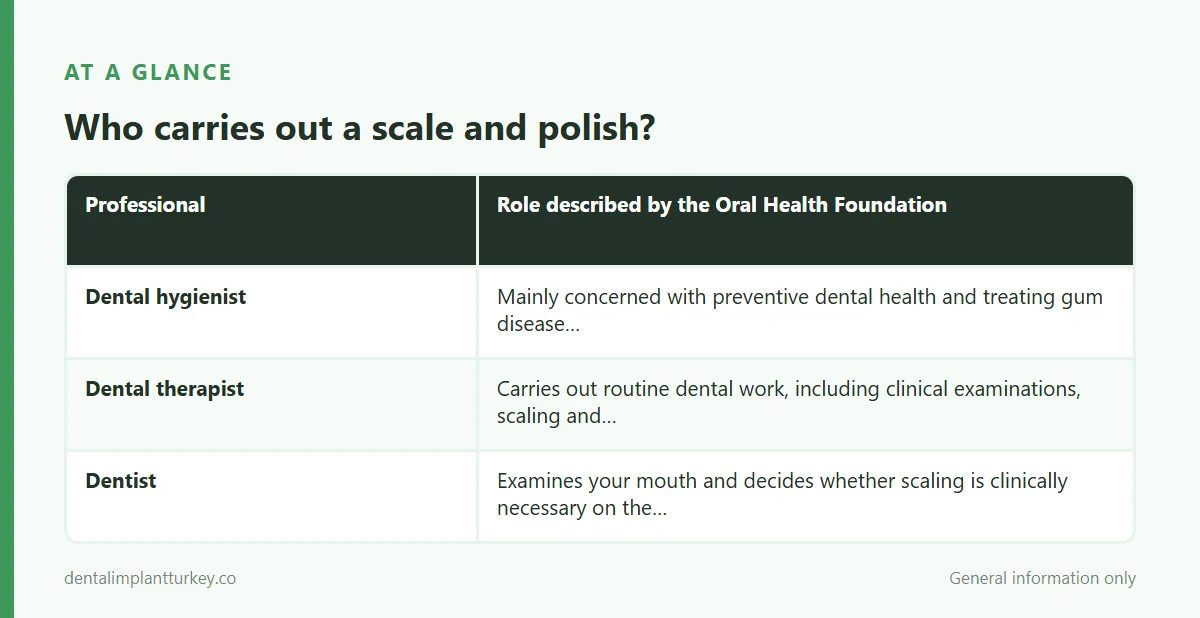
Who carries out a scale and polish?
| Professional | Role described by the Oral Health Foundation |
|---|---|
| Dental hygienist | Mainly concerned with preventive dental health and treating gum disease; carries out scaling and polishing |
| Dental therapist | Carries out routine dental work, including clinical examinations, scaling and polishing, and restoration work |
| Dentist | Examines your mouth and decides whether scaling is clinically necessary on the NHS |
The NHS confirms that scaling can be done by a hygienist or a dental therapist.
Is a scale and polish free on the NHS?
It is not free for most adults, but it is usually covered by the lowest NHS charge. The NHS Business Services Authority states that a scale and polish is a Band 1 treatment, even if more than one visit is needed. NHS England currently lists Band 1 at £27.90, and that charge also covers your examination, X-rays if needed and advice.
There are two important conditions:
- It must be clinically necessary. The NHS says that if your dental professional decides scaling is clinically needed, you can get it on the NHS. If the dentist says it is not clinically necessary, you will have to pay for it privately.
- More complex gum treatment costs more. The NHS says extensive treatment or treatment for complex gum problems may be charged at the Band 2 rate, which is currently £76.60.
Some people, including under-18s and those who are pregnant or have had a baby in the last 12 months, get NHS dental treatment free. Our guide to NHS dental charges explains the bands in full.
How often do you need one?
There is no single rule. Cleveland Clinic says many people can keep tartar at bay with cleanings every six months, while people prone to cavities or gum disease may need them more often. The Oral Health Foundation advises visiting as often as your dental team recommends. The NHS suggests a check-up at least every 2 years for adults even if you have no problems, and your dentist will tell you whether you need hygiene visits in between.
Does a scale and polish hurt?
Experiences vary, and the sources we checked do not describe a typical level of discomfort. If you are anxious, tell your hygienist before they start and say if anything feels uncomfortable during the clean. It is also worth mentioning if your gums bleed when you brush at home: the NHS lists this as a sign of gum disease, which your dental team will want to know about.
How to get more from your appointment
- Ask which areas had the most build-up so you can focus your brushing there
- Ask for a demonstration of interdental brushes in the right sizes for you
- Ask whether your gums show any signs of disease
- Ask how often you should come back
Between visits, the habits in our 10 dentist-approved tips for healthy teeth will help slow down the next build-up.
Sources
- NHS, Dental treatments
- NHS, How much NHS dental treatment costs
- NHS Business Services Authority, What band of treatment is a scale and polish?
- NHS, Who can get free NHS dental treatment
- NHS, Gum disease
- Cleveland Clinic, Tartar on Teeth (Dental Calculus)
- Oral Health Foundation, Dental professionals
This article is general information and is not a substitute for advice from your own dentist.